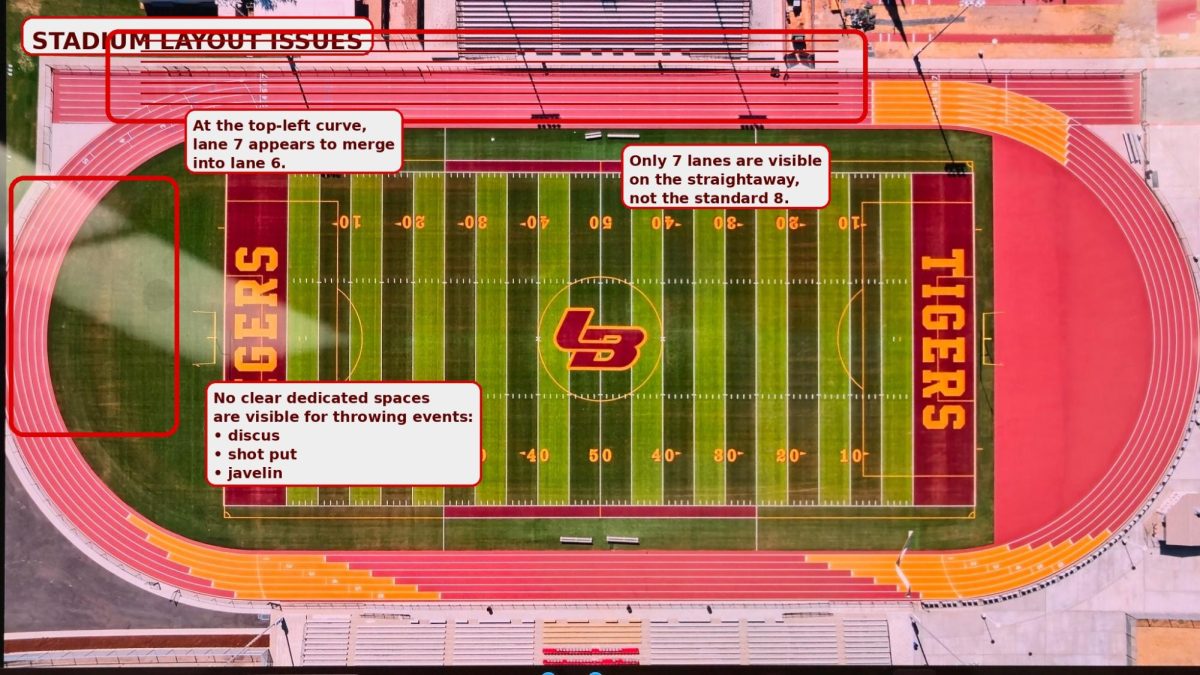
With spring sports starting up, track and field athletes are beginning to notice a major mistake on the field. The newly renovated Loftin Stadium has been a shining star for the school, a project passed in 2018 and announced in 2022.
The project was funded by Measure X, which collected property taxes to refurbish the football field, concession stands, restrooms, locker rooms, and to install an all-weather paved track to replace the previously dirt track. The construction company BMY Construction was in charge of the Loftin Stadium project, with the architect being Magini Associates. The project was reported to have cost 11.1 million, according to the August 2024 article in the Merced Sun-Star.
However, many track and field athletes have noticed that the track does not have enough lanes. Students have raised concerns about missing track features, such as a throwing area and the full number of lanes needed for competitions.
Throwing athlete Alana Arnold (12) spoke on this issue. “The track is missing the proper amount of lanes needed to host a meet, so we still have to hold our meets at Pacheco’s stadium. There was a seventh lane attempted to be added, but it merges into Lane 6, and half of it is cut off by the fence and concrete.”
With a quick search on Google Maps satellite view, this design issue can even be seen from an aerial view. Arnold also reports that there is no dedicated area for throwers. “The construction completely got rid of the previous throwing areas at the stadium, so now we have to practice on the school field.”
Jonathan Razo (12), a four-year track athlete, also shared concerns. “The average track and field standard for a competition is eight lanes. Loftin Stadium only has six. Our meets take very long, from 10 a.m. to 6 p.m., so having more lanes would help the meet go quicker since more runners could compete at once.”
Thrower and football player Javier Conteras (12) voiced how he felt throwing events had been overlooked. “I don’t feel like track and field athletes were considered in the stadium design. The track is too small, we still have the same jumping areas as before renovation, and there are no throwing areas in the stadium.” As both a football player and a track-and-field athlete, he feels the stadium design catered more toward football. “It is track and field, not just track.”
With concerns like these, some track and field athletes feel the stadium’s budget does not fully reflect their needs. If millions were spent on renovations, why are certain track-and-field features still missing? With many athletes feeling overlooked in the design process, frustration has grown among team members.
When contacted for a response, BMY Construction declined to comment. The athletic director and the school principal were also asked via email to be interviewed, but both have been radio-silent. The lack of accountability raises an important question: What does this say about the school’s priorities and commitment to all student-athletes?